
Got your TAM/SAM/SOM? That's great. You know your numbers.
So, what's next?
You built your financial model. You calculated your Total Addressable Market. You secured your UKCA or CE mark. Your executives and/or investors expect revenue.
You present your device to a large NHS Trust. The clinical leads praise the technology. The procurement team rejects the proposal. A large market size on a spreadsheet does not guarantee adoption.
You need a specific entry strategy to get your product to clinicians and patients.
Choose focus over broad distribution
Consider two medtech companies launching a new diagnostic wearable in the UK.
Company A targets the entire NHS simultaneously. They send marketing materials to cardiology departments across all 135 acute hospital provider Trusts. They wait for inquiries. They deplete their capital in twelve months.
Company B targets three specific NHS Trusts. They choose Trusts with a stated strategic goal to reduce heart failure readmissions. They prove their wearable reduces readmissions by 15%. They use this data to secure contracts with ten more Trusts within their region the following year.
Company B succeeds because they focused their resources. You must do the same.
A multi-billion TAM or multi-million SAM means nothing if you cannot secure and execute your first contract.
Determine who pays first
You must first determine who pays for your product. You have three main options in the UK:
Patients pay out of pocket through private healthcare providers.
Local NHS Trusts or ICBs pay from their operating budgets.
National NHS programs pay through frameworks like the MedTech Funding Mandate.
Securing a NICE recommendation and national funding mandate can take three to five years. This can bleed resources quickly. You must target the local NHS Trust or ICB budget first.
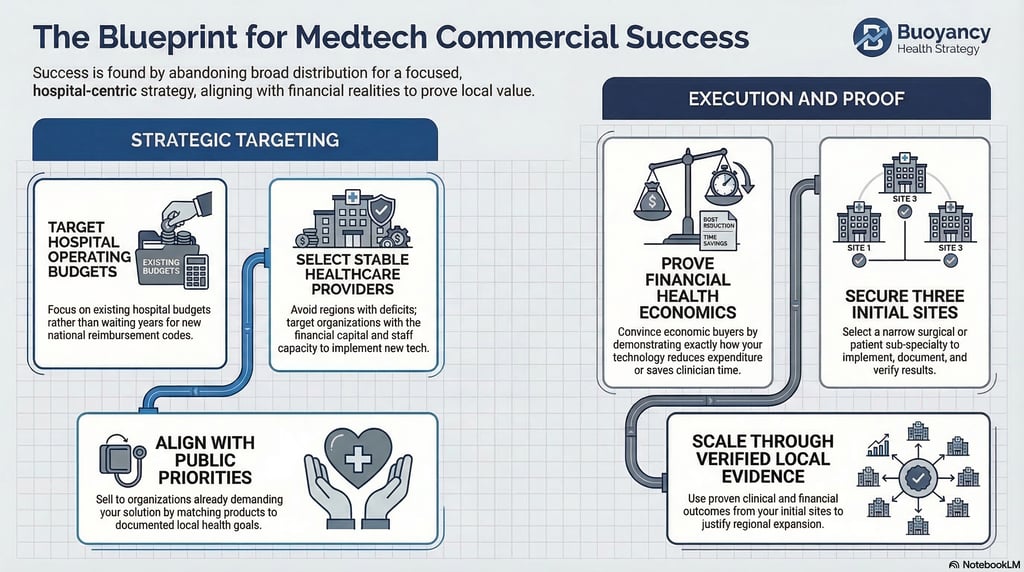
Target trusts with available capacity (clinical, financial, operational)
To win hospital budgets, you must locate facilities capable of buying your product. Avoid regions struggling with basic or highly challenged operations.
Trusts facing deficits lack the cash to buy new technology. They lack the staff time to train users or change clinical pathways.
Target NHS Trusts with available capital. Look for organisations showing financial stability. Review their published board papers and annual reports. Identify sites with the operational capacity to implement your system.
Align with ICB priority lists
Your product must solve a documented problem for the buyer. Read the Joint Forward Plans, commissioning intention plans, and strategy papers published by Integrated Care Boards (ICBs). Find exact mentions of your technology category.
If you sell remote patient monitoring software, look for ICBs allocating funds to out-of-hospital care. The UK government allocated £250 million to increase virtual ward capacity in 2023. Target the specific regions actively utilising this funding.
If you sell surgical equipment, look for Trusts publicly stating aggressive targets for elective recovery and waitlist reduction.
Sell to the NHS organisations that already possess a documented strategic mandate and the budget to buy your specific solution.
Engage early and prove financial value
Start your commercial work early. Engage NHS decision-makers six months before you plan to launch. Build your market entry plan alongside your regulatory clearance process.
Map the buying process inside your target accounts. The clinical user and the economic buyer have different motivations. A consultant wants to improve patient care; a finance director wants to reduce expenditure. You must convince both individuals.
Present health economic evidence. Clinical outcomes alone rarely secure a contract with NHS Supply Chain or local procurement. You must prove financial savings.
Show the finance director how your software automates administrative tasks and saves 15 clinician hours per week. Show the ward manager how your device reduces patient length of stay by two days. Provide peer-reviewed studies supporting these numbers.
Secure your initial target segment
Select a narrow target segment to start. Choose a specific patient demographic or a single surgical sub-speciality. Secure three initial NHS Trusts. Implement your product. Document the exact results.
NHS buyers demand real-world evidence. Gather local data. Record the clinical improvements. Track the financial savings. Compare the new pathway costs against the old pathway costs.
Present this concrete data to neighbouring Trusts. Use proven local results to justify regional expansion across the wider ICB. Expand your adoption Trust by Trust using verified outcomes.
Navigating NHS procurement structures requires precise planning and execution. At Buoyancy Health Strategy, we map out the specific commercial pathways for your medtech/ healthtech product. We help you identify the right ICBs, locate the Trusts with available capacity, and structure your value proposition for the economic buyers holding the budgets.
Buoyancy Health Strategy
Steady. Strategic. Scalable Healthcare Growth
© 2026 Buoyancy Health Strategy Ltd. All rights reserved.