
The convergence of Digital Health, MedTech, and Pharma
Changes in the healthcare landscape from a collection of siloed product providers into integrated value-delivery ecosystems.
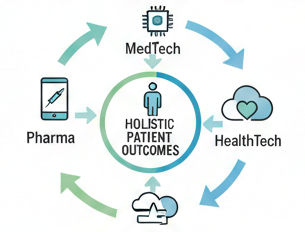

Earlier this year we looked at a new pathway that is characterised by a shift in care settings and a reliance on technological convergence to deliver holistic patient outcomes. (You can read it here.)
In 2026, we've seen the a transition from Consolidation in 2026 marks a transition from acquiring standalone products to securing integrated data and service capabilities. The industry is moving away from disparate hardware sales toward revenue models built on long-term clinical utility and pathway control.
This briefing outlines the strategic imperatives, provides three examples of this trend in 2026, and describes operational realities and what this means for you right now.
1. Strategic drivers of the convergence
Market consolidation is driven by the necessity to bridge the gap between "product" and "patient outcome" rather than portfolio expansion.
Data-driven value ecosystems: Consolidation is fueled by the need to capture and analyse patient-level data across the entire care pathway. Industry players are acquiring digital health assets to move beyond hardware/drug sales toward "360-degree" industry intelligence, integrating pipeline visibility with clinical study data and market modeling.
Integrated service wraps and service-led growth: Successful commercial models now prioritise "service wraps" around medical devices and pharmaceuticals. By bundling digital monitoring, patient support services, and diagnostic tools, companies are moving toward a service-led commercial approach that simplifies adoption for NHS and global health providers.
Efficiency and scale: Large-scale mergers, such as those within public health bodies or multinational diagnostic firms, are prioritising the rationalisation of operating models. Consolidating commercial directorates often resulting in significant headcount or cost reductions is a primary driver for post-merger value realisation.
The following three examples demonstrate the shift toward platform-based value in 2026 :
Boston Scientific / Penumbra: This acquisition expands Boston Scientific’s neurovascular footprint. By securing Penumbra’s clot-removal portfolio, the firm captures a high-growth segment, directly increasing its competitive standing in stroke and aneurysm procedures.
Danaher / Masimo: Danaher is embedding AI-enabled patient monitoring into its diagnostic infrastructure. The transaction secures long-term revenue through data services, ensuring the company maintains a central role in clinical monitoring environments.
AstraZeneca / Modella AI: AstraZeneca’s purchase of this startup integrates foundation models into oncology R&D. The goal is to accelerate biomarker discovery and clinical development, effectively replacing slower, traditional research methodologies with automated AI-driven processes.
2. Implementation challenges
Moving from strategic planning to successful market consolidation requires navigating high levels of operational complexity:
Alignment of incentives: Merging organisations must reconcile disparate commercial structures (e.g., Pharma’s focus on HTA/reimbursement vs. MedTech’s focus on procurement/pathway integration) into a unified go-to-market (GTM) strategy.
Operating model rationalisation: The greatest risk to value capture post-merger is structural complexity. Designing a Target Operating Model (TOM) that minimises this while maintaining agility is critical to avoiding the stagnation that often follows large corporate integrations.
Market access variability: A consolidated portfolio often struggles with "value fragmentation," where the perceived value of a drug vs. a device vs. a digital tool varies wildly across different health systems, stakeholders, and reimbursement environments.
3. So, what’s does this mean for you?
For growth companies and multinational organisations alike navigating this consolidation, the focus must shift to three pillars:
Strategic positioning: Articulating a value proposition that integrates the product/service offering into the existing clinical pathway rather than positioning it as an add-on.1
Operational optimisation: Ensuring that post-merger commercial functions are lean, agile, and aligned with national/local healthcare priorities (e.g., shifting toward system-based contracting).46
Actionable growth roadmaps: Developing clear, phased market entry strategies that identify high-potential adoption sites (e.g., using NHS provider datasets) to ensure immediate revenue growth post-integration.
Buoyancy Health Strategy
Steady. Strategic. Scalable Healthcare Growth
© 2026 Buoyancy Health Strategy Ltd. All rights reserved.