
The illusion of Product-Market Fit
Why you need Product-Health System Fit instead


If you are a strategy director or market access leader in a healthtech or medtech firm, you have likely sat through countless meetings where "Product-Market Fit" (PMF) is discussed as the holy grail of commercial viability.
If you're an investor, you've seen countless decks with billions of £/$/EUR in market size (I've written other insights pieces on market size topic here and here.).
It is a concept borrowed directly from Silicon Valley B2C and B2B SaaS playbooks. In standard tech, the premise is simple: build a product that solves a severe pain point for a specific user, and that user will gladly pay you for it. Demand meets supply in a frictionless transaction.
In healthcare, operating under this assumption is a fast track to failure.
Healthcare is not a traditional market; it is a complex, highly regulated, and behaves like an adaptive system. Having a medical device or digital health app that patients love and doctors find clinically effective is functionally useless if it does not align with the economic realities of the reimbursement system.
To survive and scale, healthtech firms must abandon the pursuit of Product-Market Fit and ruthlessly optimise for Product-System Fit.
The misaligned triad is the reason for PMF failure
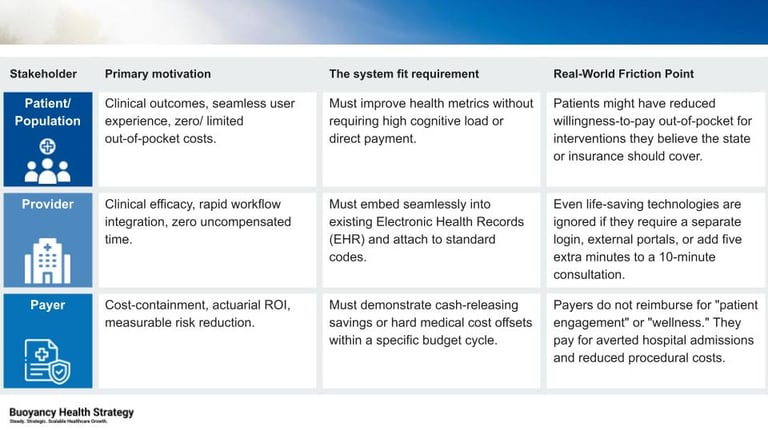
Traditional PMF assumes the end-user and the economic buyer are either the same person or share identical incentives. Healthcare breaks this rule entirely and operates as a multi-sided ecosystem defined by a triad of stakeholders and none of whom share the same primary motivations.
To achieve Product-System Fit, your innovation cannot just solve a problem for one stakeholder. It must simultaneously move the needle across this triad without triggering the system's immune response.
When a medtech firm achieves PMF without PSF, they have built a fantastic product that no one will pay for. To understand how this plays out in the real world, let's examine two health markets in Europe: Germany and the UK.
Germany: The DiGA Fast-Track and the reality of system friction
Germany is frequently lauded as a pioneer in digital health reimbursement with its DiGA (Digitale Gesundheitsanwendungen) fast-track pathway. On paper, it looks like a PMF utopia: if your digital health application passes the Federal Institute for Drugs and Medical Devices (BfArM) assessment, doctors can prescribe it, and all 93 Statutory Health Insurances (SHIs) are legally mandated to pay for it.
Many international executives assume that getting into the DiGA directory guarantees commercial success. The reality is a masterclass in the difference between a market and a system.
The System fit hurdle
First and foremost, getting onto the DiGA directory is not an app store submission. The the time of writing in July 2026, there are around 78 DiGAs listed (provisional and permanent), covering a range of indications from mental health, neurology disorders, chronic conditions, to musculoskeletal disorders. However, the attrition rate for companies that fail to understand the system is brutal.
Evidence and provisional status: The fast-track offers a provisional 12-month listing, during which manufacturers must prove a "positive healthcare effect" (medical benefit or patient-relevant structural improvement) through comparative studies. If your evidence generation cannot align with BfArM's strict requirements within that window, you are removed from the directory.
The prescription bottleneck: Even with a listing, you must overcome physician workflow friction. A DiGA is assigned a Pharmazentralnummer (PZN, the standard German pharmaceutical central number). To achieve PSF, your marketing and field teams must convince a doctor not just that the app works, but that prescribing it through their existing software interface is worth their time.
The price of ignorance: Data shows that manufacturers who try to navigate this without early, systemic alignment fail. The withdrawal and rejection rate for DiGA applications sits at roughly 63% for companies that do not consult with BfArM prior to submission, compared to just 35% for those who do.
In Germany, Product-System Fit means recognising that clinical efficacy is merely the entry ticket. Commercial scale requires proving specific, BfArM-approved endpoints and integrating flawlessly into the legacy prescribing habits of the German medical establishment.
The UK: Why NICE approval is not a purchase order
If you ask a healthtech strategy director in the UK what their primary commercial goal is, they will likely say: "Getting a positive recommendation from NICE (The National Institute for Health and Care Excellence)."
This is a dangerous half-truth. In the UK’s National Health Service (NHS), achieving regulatory approval (UKCA/CE marking), generating positive clinical trial data, and securing favorable NICE guidance does not equate to system adoption. The NHS is highly fragmented into 36 Integrated Care Systems (ICSs) and over 200 hospital and community provider Trusts.
You can have overwhelming Product-Market Fit where patients love your device, and surgeons want to use it, but spend years sitting unused because you lack Product-System Fit.
The evolution of the budget cycle trap
For years, the NHS was paralysed by the annual budget cycle trap" Procurement was treated as a commodity exercise driven by the lowest upfront price. If a £5,000 device prevented a £50,000 complication five years later, local buyers couldn't fund it because they were bound to a strict 12-month budget constraint.
This landscape is now slowly shifting. With the Medium Term Planning Framework (covering 2026/27 to 2028/29), the NHS has moved away from short-term annual planning toward a three-year financial window.
While this theoretically gives medtech more breathing room to prove long-term value, the reality is a double-edged sword. Under this new framework, all ICBs and Trusts are legally mandated to deliver break-even financial positions without deficit support funding, alongside mandatory 2% annual productivity improvements.
The implication? Your product no longer has to solve an annual cash problem, but it must demonstrably drive that mandated 2% productivity gain or alleviate urgent care backlogs within the new three-year window.
The new value-based procurement reality
Adding to this systemic shift is the Value Based Procurement (VBP) national standard guidance for medical technology, published jointly by the DHSC and NHS England in June 2026. This framework officially forces NHS buyers to assess medtech across five domains:
Social value
Efficiency
Patient and staff outcomes
Supply chain resilience
Product purpose
For market access directors, your definition of Product-System Fit has been rewritten by the government. The days of winning a tender strictly on clinical efficacy and unit price are over. If your healthtech cannot explicitly map its value to workforce efficiency (e.g., shifting procedures from inpatient to day-case, reducing staff time) or supply chain resilience, you will lose the tender to a competitor who can.
The burden of proving that value locally now falls entirely on your commercial field teams navigating the new VBP framework and three-year planning cycles.
In the UK, if your product improves "quality of life" but does not drop hard cash savings into the local Trust's budget within 36 months, you do not have Product-System Fit. You will be doomed to endless, localised "pilot purgatory."
A blueprint for establishing Product-System Fit
Executives must pivot their strategic frameworks away from consumer-centric PMF and towards system-centric PSF. Before launching , answer the following three systemic test questions:
1. Workflow test
Question: Does this product require the clinician to alter their existing behavior, open a new software window, or spend uncompensated time?
Action: If the answer is yes, halt development. Redesign the intervention until it attaches seamlessly to the existing clinical pathway and current billing/prescribing codes (like the PZN in Germany).
2. Economic buyer test
Question: Who exactly signs the check, and what is their financial time horizon?
Action: Map the economic flow. If you are selling to an NHS Trust in the UK, your value proposition must focus on immediate operational efficiencies (e.g., reducing length of stay, freeing up theater capacity). If your ROI takes five years to materialise, you must redesign your pricing model (perhaps through risk-sharing agreements) to make the year-one math work for the buyer.
3. Evidence test
Question: Are we generating clinical data for regulators, or health economic data for payers?
Action: Stop running clinical trials purely to prove your tech is safe and effective. Design your trials around the endpoints that the payer actually cares about. For Germany, this means aligning with BfArM’s specific definitions of "positive healthcare effects." For the UK, this means capturing the granular resource-use data required to build a budget impact model that proves net savings within three years.
Concluding thoughts
Product-Market Fit can become a distraction in healthtech. It encourages companies to build elegant solutions to clinical problems while ignoring the fragmented, highly incentivised infrastructure that dictates how care is paid for.
Whether you are navigating the strict evidence requirements of Germany's DiGA pathway or fighting for localised adoption within the UK's NHS, the mandate remains the same.
Stop asking, "Do users want this?"
Start asking, "Can the system absorb and pay for this without friction?"
The companies that master the latter will command the market; the rest will simply run out of runway.
Buoyancy Health Strategy
Steady. Strategic. Scalable Healthcare Growth
© 2026 Buoyancy Health Strategy Ltd. All rights reserved.